The next bottleneck in medicine isn’t finding drugs. It’s making them.
Drug discovery is about to have its Cambrian explosion. AI will flood the pipeline with new medicines. But they’ll hit a brick wall: manufacturing.1 We can discover drugs at the speed of silicon, but we still make them at the speed of cells.
Every technological revolution shifts the bottleneck downstream, and drug discovery is next. The frontier AI labs are moving into biology, a sign they see where the bottleneck is heading. But over the last decade, investors poured billions into teaching AI to find drugs, and almost nothing into teaching it to make them.
Ark is teaching AI to make drugs. Today, Ark’s models direct experiments inside some of the world's largest pharmaceutical companies, and on one recent program lifted yield 43% above the company’s historical best, meaning far more drug from every run.
COVID: 48 hours to design a vaccine, 16 months to make enough
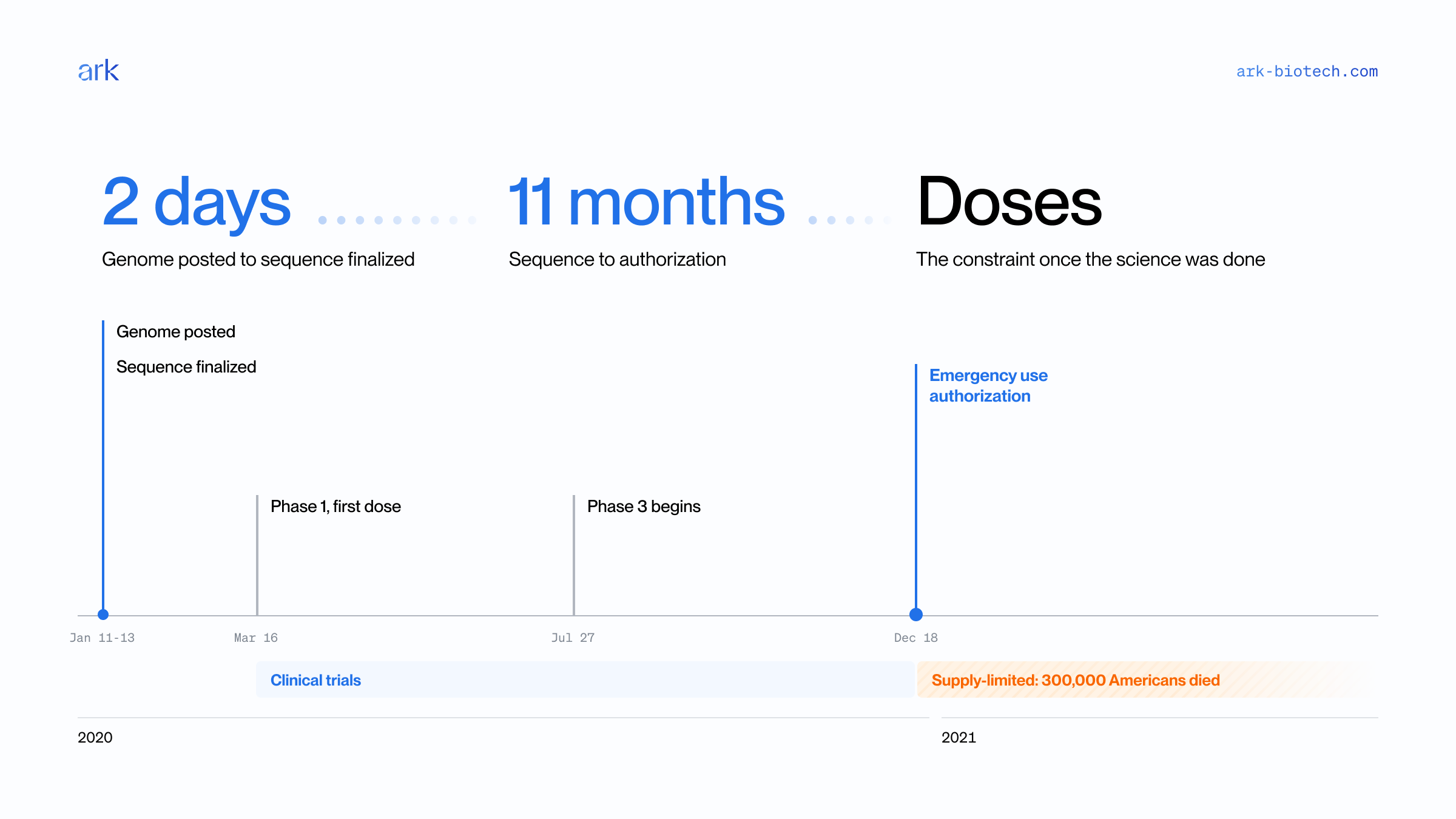
Designing the COVID vaccine took 48 hours. Making enough doses took 16 months. Between authorization in mid-December 2020 and May 2021, when anyone who wanted a dose could get one, nearly 300,000 Americans died.
Moderna and NIH finalized the mRNA-1273 sequence on January 13, 2020, two days after the viral genome was posted. Trials ran through the year, and authorization came in mid-December. From that point the science was finished and the trials had succeeded, but supply was limited. Hesitancy and logistics played their part, but for most of that window the constraint was the number of doses that existed.
COVID exposed the manufacturing bottleneck. Every drug hits an earlier one: turning a sequence into a process. A standard antibody takes 12 to 16 months to go from DNA to the clinic, which is too long for a patient with no other options. And the labs that do this work are sized for today’s pipeline. When the flood arrives, new drugs will wait in line. In the worst case, drugs that can change lives will be shelved as labs need to prioritize limited capacity.
Drug manufacturing: the industry that never built a simulator
Every other high-stakes engineering discipline runs on prediction. Boeing does not build a wing to find out whether it flies. TSMC does not fabricate a chip to see whether the gates switch. They simulate first and build what the simulation approves. Drug manufacturing is the exception. A process is found by running experiments until one works.
Nobody skipped the simulator out of laziness. It could not be built. The two classic approaches for scientific modeling each fail here:
Machine learning needs data, and a single cell culture run takes two weeks and costs as much as a car. The models that conquered text trained on billions of examples, and here they get dozens.
Multiphysics needs equations, and the equations for how biology interacts with the physical world have not been written.
There’s too little data for AI alone, and too little settled science for physics alone. So the industry kept running slow, expensive experiments instead.
The obvious move is to combine the two, and the industry has tried. A physics-informed neural network, for example, uses physics as a penalty that nudges the neural network toward plausible answers. But the network is still doing the learning, and the physics is only a guardrail. When data is thin, you’re back to a neural network that doesn’t have enough data to learn from.
Ark built a foundation model, a world model of the living process, for the problems where most of science actually lives, where data is sparse and physics is partially known. Ark’s architecture is inverted: the neural network is not outside the physics, it is a term inside it. The learned biology sits inside the equations for mass transfer, mixing, and acid-base chemistry, and the whole system is solved together in a numerical integrator we built for science. The result is a model that is sample-efficient by construction: it reaches predictive accuracy on the few runs a new molecule gets, not the billions of examples modern AI assumes. And the simulation runs in seconds, thousands of times faster than the batch it models, fast enough to make decisions while the batch is still running. We call it multiphysics-first AI. Drug manufacturing is where we are proving it, but it is a foundation for scientific intelligence well beyond drugs.
Agents close the loop, from lab to plant
The world model predicts where every run is heading. Agents act on it, changing the run while it is still going. More decision points, with higher quality choices. In R&D, this means learning more efficiently to reduce the number of experiments that need to be run. In manufacturing, this means an army of agents vigilantly guarding every batch.
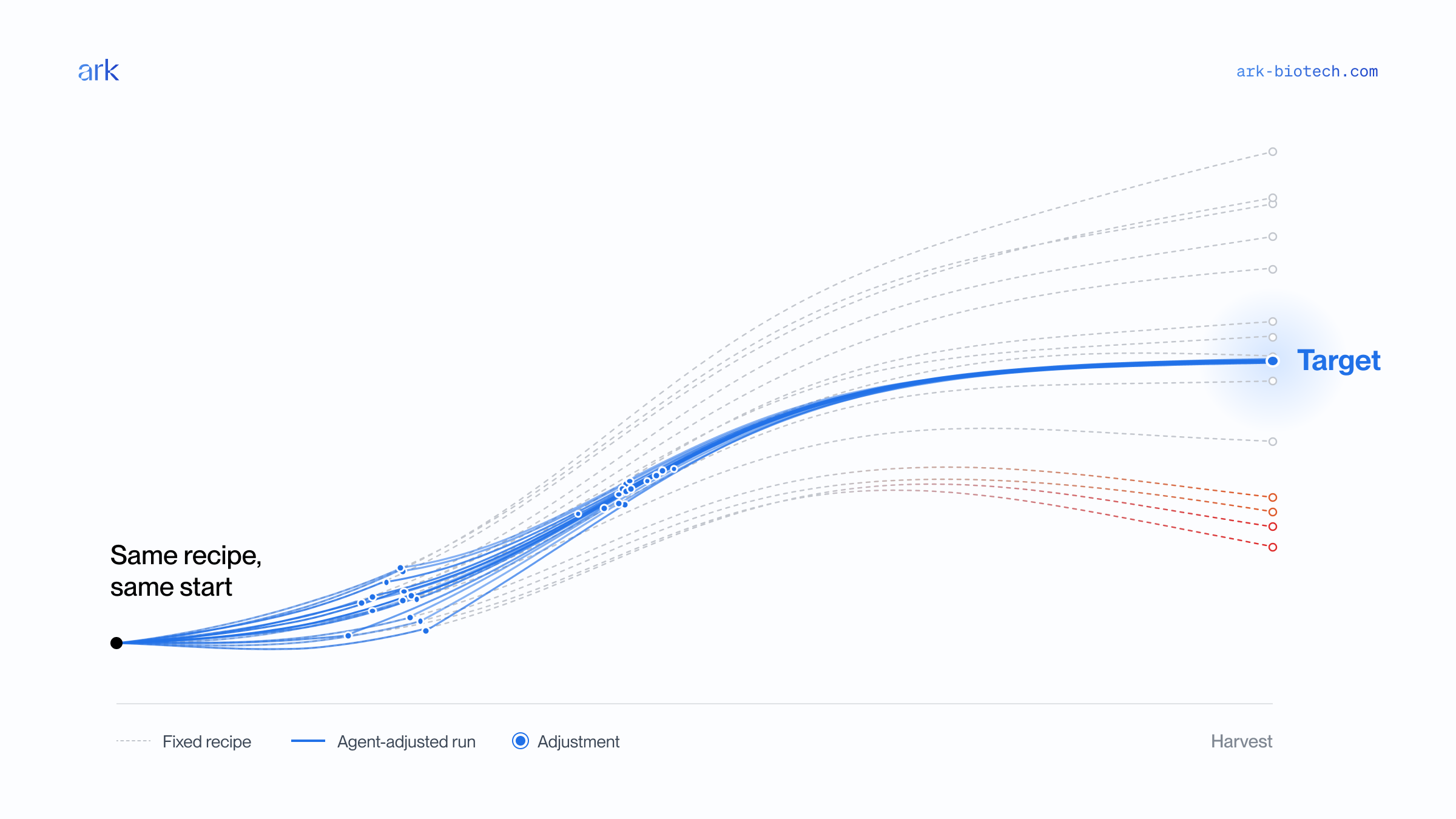
R&D: lab-in-the-loop. A process that took five years and 300 experiments now takes a month and 10. The goal of every campaign is the same: teach the foundation model what makes this molecule distinct. The model designs each experiment to maximize information gain, and then does what a fixed recipe never could: it learns while the cells are still growing, and with every new data point it redirects the experiment toward what it still does not know. The same real-time steering, pointed at yield instead of learning, lifted one company’s output 43% above its historical best in three weeks.
Manufacturing: agents on the plant floor. Agents do two jobs on the plant floor. The first is monitoring. A single commercial batch can be worth a billion dollars, but is still monitored much as it always has been: scientists inspect trend lines, and an alarm fires once a limit has already been crossed. By then the cost is already incurred: most deviations mean extra testing, an investigation, and weeks of delay before the batch can ship, and the worst lose the batch entirely. Agents plus simulation change this. Agents watch every signal the reactor produces, continuously simulating where the batch is heading. When the probability of a bad outcome rises, hours before any limit is crossed, they find the correction that brings the batch back and hand it to a scientist with the reasoning attached. Every run ends with a plan to make the next one better.
The second job is control. Every batch today runs on a recipe fixed before inoculation, which works only if the cells behave similarly every time. Many do not. One life-saving drug we work on carries hundreds of millions of dollars in every batch, and its cells behave differently every run, in ways that show up only once the batch is under way. No fixed recipe can hold a process like that. Agents can: they adjust the run as it unfolds, keeping each batch on course however its cells behave. Ark’s digital twin runs this way on commercial batches.
The day after discovery is solved
If manufacturing keeps pace with discovery, the day after looks like this. A molecule designed on Monday has a manufacturing process by the end of the month. Trial material ships in a quarter, not a year or more. The process travels as a model to whichever plant has capacity, and every batch runs with agents watching it, so a lost run becomes an exceptionally rare event. A patient waiting on a new medicine waits on the trial, not on the plant.
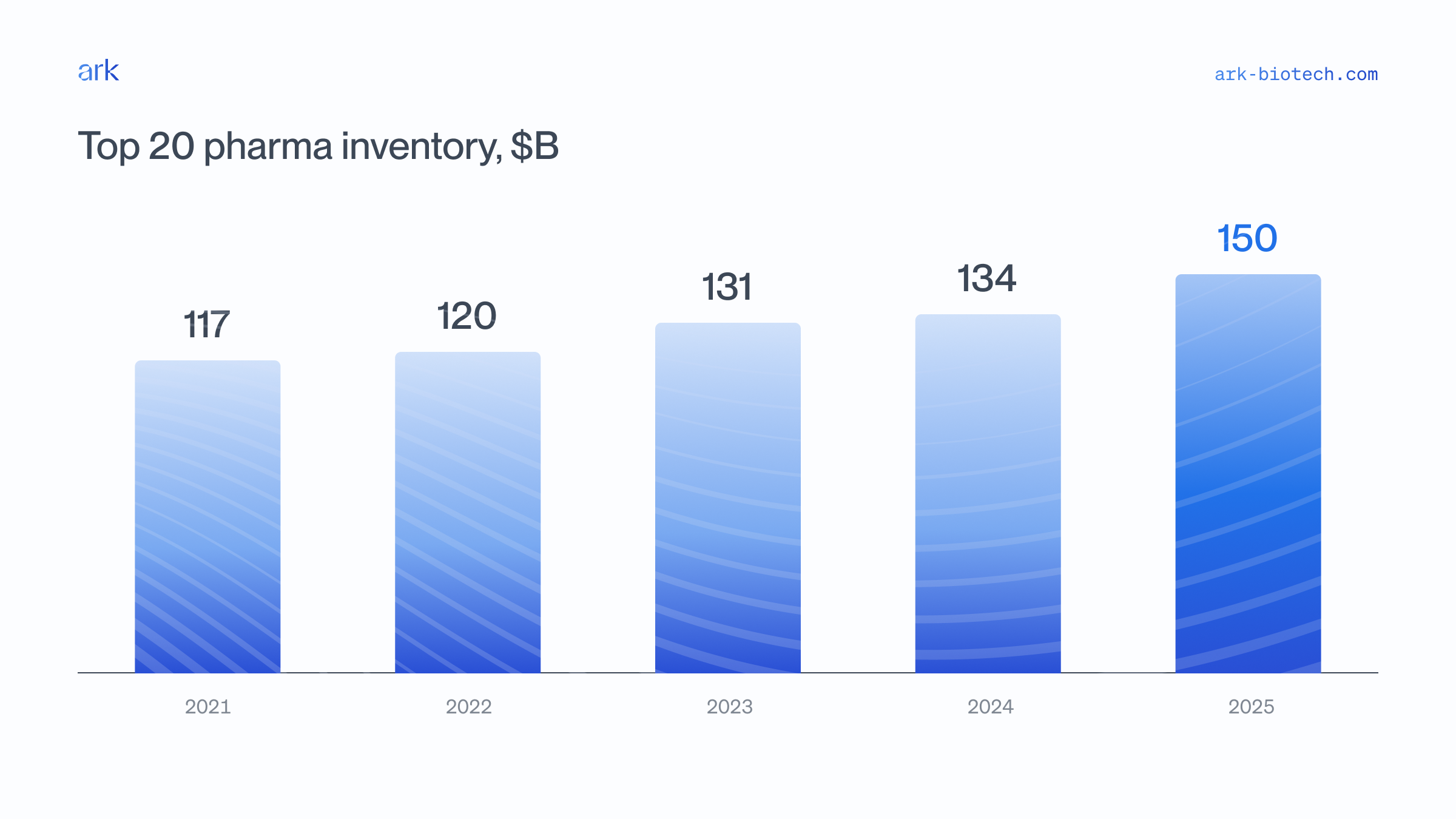
Cost.$150 billion. That’s how much inventory the largest pharma companies hold, more than eight months of supply, in part because nobody can be sure the next batch will work. On top of that are the costs associated with the hundreds of experiments it takes to develop a process, and the extra commercial runs needed when yield falls short. A model that can predict and improve performance cuts all three: less stock held as buffer, fewer experiments, and more drug from every run.
Volume. Cheap discovery will produce an explosion of candidates. Only cheap manufacturing lets a company pursue them. When the cost of a shot on goal falls, companies take more shots, and programs that were never worth a year of development become worth a month of it. Rare diseases, small patient populations, cell and gene therapies, and eventually medicines made for a single patient (n=1) stop being economically marginal. So do longevity medicines, which only work at a price healthy people can pay for decades. AI discovery widens the top of the funnel. AI manufacturing widens the bottom, so more of those candidates become medicines that reach patients.
What Ark is building
The first wave of AI in pharma is teaching machines to find drugs. The second will teach them to make those drugs, and it will become the intelligence layer every medicine is made on. Ark is building that layer.
Its value recurs. Discovery creates a molecule once. Manufacturing must recreate it, reliably, batch after batch, for as long as patients take it, and the number of drugs is about to multiply. When the process for every molecule lives in a model, the model is where manufacturing is decided and the plant is where it is carried out. There is no category for this yet. We are building the company that defines it.
Most of AI for science bets on bigger models and more data. This problem cannot wait for that data, so we solve physics and AI as one. The same intelligence drives autonomous R&D and self-correcting manufacturing.
And it compounds. Each program sharpens the foundation beneath it, so the next molecule starts from a better guess than the last, even when the data stays with the company that made it. The more programs the model learns from, the better it gets for every partner. Today, we are building it with the world’s leading pharmaceutical companies.
The flood of new medicines is coming. The brick wall does not have to be.
1 AI drug discovery will also hit a second (taller) brick wall - clinical trials. Both bottlenecks need to be addressed with gains additive to reducing R&D costs and increasing throughput. AI is already starting to accelerate clinical trials through cutting down on recruitment time (e.g., faster site and patient selection) and improving trial design (e.g., more statistical power from fewer patients). The ultimate opportunity is for AI to enable predictions reliable enough to move part of clinical trials in silico